Community
Strokes of an Artist: Maynard Dixon Lines
Maynard Dixon: The Artist Who Found His West in Southern Utah
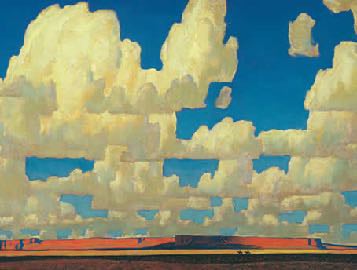
Few artists captured the American West with the quiet authority of Maynard Dixon. His paintings can seem deceptively simple: broad bands of earth and sky, a distant mesa, a cottonwood, a rider or solitary figure. By stripping away the unnecessary, Dixon focused on the essential character of a place—its scale, solitude, light and atmosphere.
For residents and visitors to Springdale and Zion National Park, Dixon's story has a special local connection. Although his Southern Utah home was in Mount Carmel rather than Springdale, Zion Canyon and the surrounding landscape became increasingly important to him during the final decade of his life.
A Lifelong Search for the West
Born in California in 1875, Dixon was largely self-taught. He became a successful illustrator as well as a fine artist, traveling widely and painting Native American communities, cowboys, ranchers, miners and settlers, but above all the Western landscape.
His mature paintings often feature low horizons, immense skies and mountains reduced to powerful geometric forms. The result feels remarkably modern. Dixon was less interested in picturesque scenery than in conveying the character of the West.
His personal life also intersected with important artistic currents of the era. He was married to photographer Dorothea Lange from 1920 to 1935. In 1937 he married artist and muralist Edith Hamlin, who would share his growing attachment to Southern Utah.
Dixon and Zion
The Dixon family's Southern Utah story began in 1933, when Maynard Dixon, Dorothea Lange and their two young sons spent the summer in the Zion and Mount Carmel area. Dixon was deeply impressed by the red, peach and white sandstone, vegetation and enormous skies.
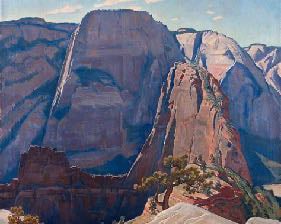
One result was High in the Morning, (right) painted that year and depicting the Great White Throne in Zion. Rather than presenting a sweeping panorama, Dixon brought the sandstone wall close, emphasizing massive forms, light and shadow. The Brigham Young University Museum of Art notes the unusual close-up composition.
For someone standing in Springdale today, the connection is striking. The cliffs framing Zion were not simply scenery to Dixon; they became subjects he studied, sketched and transformed through his distinctive visual language.
The Mount Carmel Home
Dixon and Hamlin eventually established a summer home in Mount Carmel, completing their pioneer-style log house around 1939–40. The property included the house, studio, garage/studio, bunkhouse and other structures, surrounded by native materials, trees, an irrigation ditch and open meadow.
The property was placed on the National Register of Historic Places in 2002.
From Mount Carmel, Dixon had access to a remarkable variety of landscapes: Zion, the Virgin River country, plateaus, mesas, cottonwood-lined fields and the high desert. He painted the spectacular, but he was equally interested in ordinary things—a field, a dirt road, a tree, a distant ridge or changing light on a cliff.
That sensitivity is one reason his Southern Utah paintings still resonate with people who know the country firsthand.
Looking Closely at Dixon
Dixon's Zion paintings aren't photographic records. He reduced scenes to their visual essentials.
In High in the Morning, for example, the sandstone formation becomes almost abstract. We feel the weight of the rock rather than simply recognizing "Zion." Strong areas of light and shadow describe the canyon walls, while the limited sky keeps the scene from becoming a conventional postcard.
That was characteristic of Dixon's mature style: simplify, strengthen and let the landscape speak for itself.
The Brigham Young University Museum of Art holds what it describes as the largest collection of Dixon's work, including High in the Morning and numerous other Western landscapes.
A Home, a Studio and a Final Resting Place
Dixon suffered from emphysema and declining health, spending winters in Tucson and summers in Mount Carmel when he was able. He died in Tucson in 1946.
Edith Hamlin eventually brought his ashes back to Mount Carmel. They were scattered on the hillside above the property, overlooking Sugar Knoll and Diana's Throne, landmarks Dixon had painted repeatedly.
It is a fitting conclusion for an artist whose work was so deeply tied to place. Dixon spent his career painting the West; in the end, part of him literally became part of the Southern Utah landscape that inspired him.
Visiting Maynard Dixon Country
The strongest surviving physical connection is the Maynard Dixon Legacy Museum in Mount Carmel. Operated by the Thunderbird Foundation for the Arts, the site preserves Dixon and Hamlin's home, studio and grounds and offers self-guided and docent-led tours.
It is a living-history museum rather than a conventional fine-art museum, and the Dixon paintings displayed there are reproductions rather than a large collection of original canvases.
Thunderbird Foundation for the Arts — Maynard Dixon Home & Studio
For original works, the Brigham Young University Museum of Art in Provo is particularly important, with a significant collection of Dixon paintings.
BYU Museum of Art — Maynard Dixon material
For visitors staying in Springdale, a trip to Mount Carmel can add another dimension to a visit to Zion. Instead of simply seeing the cliffs as scenery, you can consider them through the eyes of an artist who spent years trying to understand them.
Stand in Springdale and look toward Zion. The cliffs can seem almost too dramatic to be real. Dixon reminds us that the West is not only about grand landmarks. It is also about the changing color of sandstone, a shadow crossing a mesa, cottonwoods beside an irrigation ditch, or an immense sky over seemingly empty ground.
That was Maynard Dixon's great gift: he made the West feel both monumental and intimate.
And in the landscapes around Springdale, Zion and Mount Carmel, we can still see the country that helped him do it.
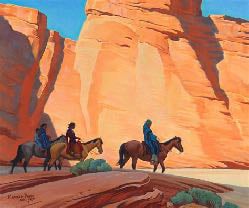
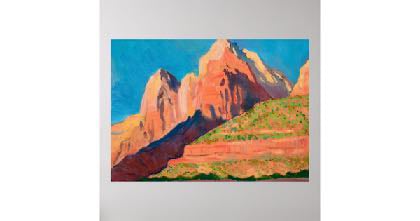
“Navajos in a Canyon” (above) “Cloud World” (left) “Zion National Park Landscape” (right)